How to Practice Forest Bathing: A Simple Step-by-Step Ritual
1. Why Forest Time Rarely Feels Restful Anymore
If you spend most of your day thinking, planning, solving, and switching contexts, your nervous system is rarely idle.
Not because something is “wrong”, but because it is constantly receiving demanding input.
Many people look for calm by adding techniques: breathing exercises, apps, routines, discipline.
Forest bathing works in the opposite direction. It changes the input, not your behavior.
This article explains what forest bathing actually is, and how to practice it in a simple, repeatable way—without techniques, beliefs, or effort.
2. What Forest Bathing Actually Is
Forest bathing (often referred to by the Japanese term shinrin-yoku) is not hiking, meditation, or exercise.
At its core, it is:
Spending unstructured time in a natural environment while allowing the nervous system to receive sensory input without task or goal.
Nothing more.
You are not trying to calm down.
You are not observing your thoughts.
You are not practicing anything.
The environment does the work.
From a nervous system perspective, forests provide a specific combination of stimuli:
- non-threatening visual patterns
- natural light variations
- organic sounds
- complex but predictable textures
- slower sensory change
This combination reduces overall sensory load and supports parasympathetic nervous system activity. Not instantly. Not magically. But reliably, when repeated.
3. How Forest Environments Affect the Nervous System
Mental overload is rarely caused by “too many thoughts” alone.
It is sustained by constant high-intensity input.
Screens, alerts, artificial light, traffic noise, and task-switching all keep the nervous system in a state of readiness.
Forest environments differ in three key ways:
Reduced cognitive demand
Natural scenes require less directed attention.
Your brain does not need to constantly filter, decide, or react.
Rhythmic, non-urgent input
Wind, leaves, distant sounds, and light shifts follow patterns without urgency.
There is nothing to respond to.
Whole-body sensory engagement
You are not only seeing, but also hearing, smelling, and feeling temperature and ground texture.
This distributes attention across the body instead of concentrating it in the head.
The result is not relaxation as an emotion, but regulation as a state change.
4. The Step-by-Step Forest Bathing Ritual
This is a simple forest bathing ritual you can repeat regularly.
No optimization required.
Step 1: Choose the environment
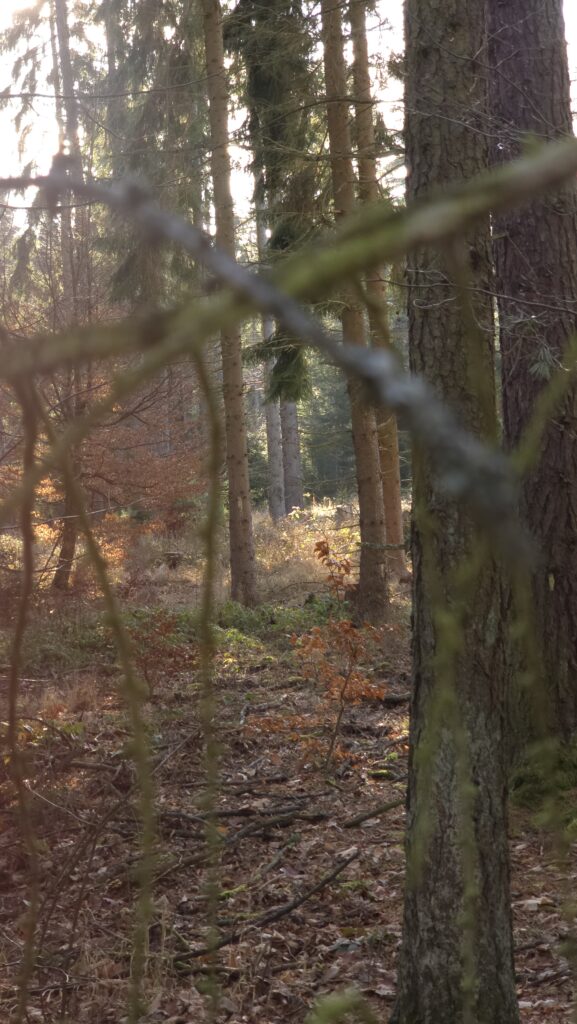
- A forest, wooded park, or tree-dense area
- Prefer uneven ground, mixed vegetation, and some depth of view
- Silence is not required; traffic in the distance is fine
Duration matters less than consistency.
Start with 20–40 minutes.
Step 2: Remove task orientation
- No fitness tracking
- No podcast or music
- No photography
- Phone on silent, out of sight
You are not here to achieve anything.
Step 3: Walk slowly, then stop
Begin with slow walking.
When you notice yourself scanning or planning, stop.
Standing still is part of the practice.
Step 4: Let attention spread
Do not focus on one object.
Allow attention to move between:
- distant and near vision
- sounds in different directions
- physical sensations (feet, hands, temperature)
If your mind shifts, do nothing.
No correction is needed.
Step 5: Sit or lean
After 10–15 minutes, sit on a log, stone, or ground—or lean against a tree.
This reduces postural effort and allows further downregulation.
Remain there until the session ends.
That is the entire ritual.
No breathing instructions.
No timing techniques.
No inner work.
5. What Forest Bathing Is Not
“This is meditation.”
No. Meditation requires active attention management. Forest bathing does not.
“I need to feel calm for it to work.”
No. State change can occur without noticeable feelings.
“I need to do this perfectly.”
No. There is no correct execution.
“One session should fix my overload.”
No. Like sleep, this works through repetition, not intensity.
Forest bathing is not an intervention.
It is a regulatory input.
6. The Principle Behind the Practice
Forest bathing works because it shifts nervous system state through environment, not effort.
You are not practicing calm—you are placing your system where calm is more likely to emerge.
7. Where This Ritual Fits in a Larger System
This step-by-step ritual is one element of a broader system for nervous system regulation through natural environments.
If you’d like gentle, step-by-step guidance instead of figuring this out on your own, I’ve created a calm, beginner-friendly Forest Bathing course on Udemy.
It’s designed to help you slow down, reconnect with nature, and build your own forest bathing practice — in a simple, grounded way.
→ Explore the Forest Bathing course